Most AI looks impressive in controlled demonstrations. Clean data, standard scenarios, straightforward decisions. Then it hits real claims: handwritten receipts, contradictory medical reports, multilingual documentation, trip-cancellation evidence — edge cases that require judgment. Accuracy drops. Oakie is architected differently.
We don't just plug in AI and hope it works. We capture your knowledge, calibrate on your data, and scale automation as accuracy proves out.
Every insurance organization has knowledge that isn't documented:
This knowledge lives in senior staff's heads. It's not in your procedure manual. It's not in any AI's training data.
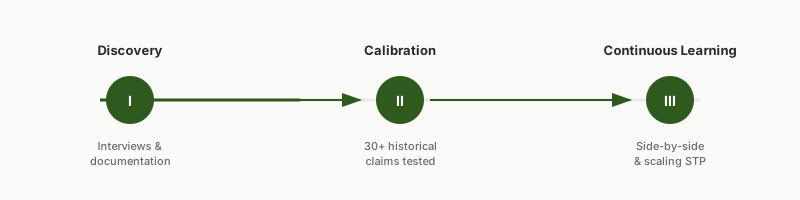
In this first phase, we interview your team and shadow your processes. By the end, we've captured ~80% of your explicit rules, forming the foundation of your unique operational logic.
We don't wait months to see results. We move immediately into calibration by running a representative set of historical claims through the system. We compare Oakie's output to human decisions to close any remaining knowledge gaps.
This is where progressive automation begins. Instead of processing a "whole file," Oakie breaks a claim into 50-100 discrete steps. We track accuracy for each step independently:
| Step | Accuracy | Status |
|---|---|---|
| Step 23 | 99.97% (4,000 consecutive correct) | Automated |
| Step 47 | 94% | Human review |
| Step 52 | 99.8% | Automated |
The strategy: If a step reaches our high-confidence threshold (e.g., 99.9%), it runs autonomously in production. If a complex step is at 94%, it stays with a human reviewer. You get the benefit of automation on day one where it's safe.
The final stage is the "side-by-side" phase. Oakie runs alongside your adjusters on live claims without taking action on its own. It acts as a "silent observer," learning from every human decision and disagreement.
This creates the automation flywheel:
This isn't one-time setup. The knowledge base evolves as your practices evolve.
The promise of AI in insurance is massive, but the reality often hits a wall: accuracy degradation. We've built a three-pillar architecture designed for high-stakes insurance decisions.
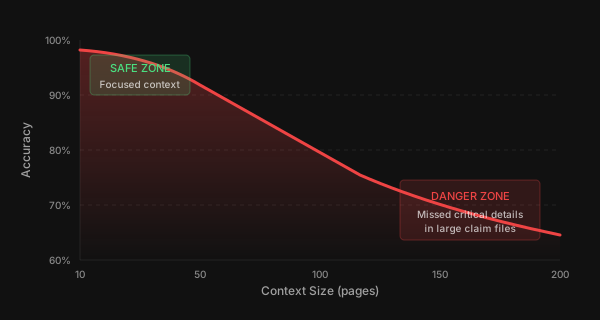
Language models have a fundamental limitation: accuracy degrades as context grows. Ask a model to find a specific date in a 10-page document and it'll probably succeed. Ask it to make a coverage determination from a 200-page claim file and it'll miss critical details buried in the middle.
A claim isn't one decision. It's dozens. We decompose complex processes into 50-100+ discrete steps:
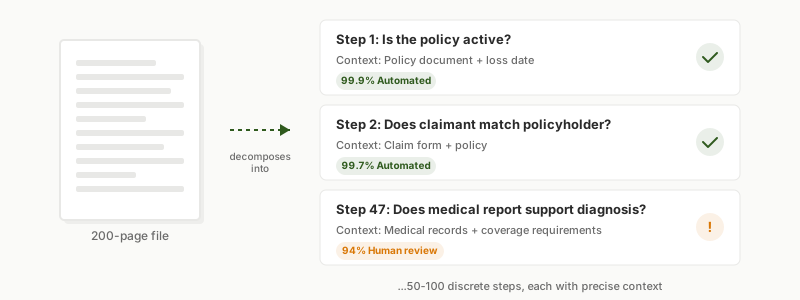
| Step | Question | Context needed |
|---|---|---|
| 1 | Is the policy active on the incident date? | Policy doc + incident date |
| 2 | Does the claimant match the insured traveller? | Claim form + policy |
| 3 | What treatment or incident type? | Medical report + incident description |
| 4 | Was pre-authorization required and obtained? | Policy terms + prior-auth record |
| 5 | Does the medical documentation support the billed codes? | Medical records + coverage schedule |
By limiting the "vision" of each step to only the information it needs, we eliminate context degradation and achieve near-perfect accuracy on discrete tasks.
The second challenge is the probabilistic nature of LLMs. To achieve the consistency required for insurance, we follow a simple rule: use AI as a last resort.
Same input, same output, every time. No AI needed.
Interpretation genuinely needed.
If a question has a mathematically certain answer, we use code, not AI. We reserve LLMs for tasks that require interpretation. This ensures consistency and eliminates unnecessary variance.
Being the most transparent platform isn't a tagline — it's an architecture. Trust in insurance AI requires visibility, not just confidence scores, so every outcome stays auditable down to the micro-decisions that produced it. Our governance framework provides three levels of oversight:
For every decision, you (and your regulators) can view the exact reasoning and evidence used for every step. If a claim is denied, you can see exactly which document was referenced and which rule was applied.
A dedicated interface for spot-checking automated decisions. By comparing a sample of AI decisions against human reviews, we track accuracy and identify any potential "drift" in the model.
Managers can track the percentage of automated results versus human-assisted ones. This allows you to decide which decisions are ready for full automation based on regulatory or business complexity.
When an error occurs in a traditional AI setup, it's a mystery. In the Oakie architecture, it's a fixable data point. "Step 47 misread the date on this document. Here's what it saw. Here's what it concluded. Here's why it was wrong."
This makes errors debuggable, explainable to regulators, and fixable without rebuilding the whole system.
Book a demo to see how our architecture handles your real private medical & travel claims complexity.
Book a demo